
- Time needed
- 20 minutes
- Difficulty
- Easy
- Cost
- Free
- Tools
- Script document and video recording
- Check
- Updated July 20, 2026
What do I really ask of a hook
For me a hook shouldn't just stop the thumb. It must orient the right person towards the right content. If it promises something that the Reel doesn't deliver, maybe it increases views, but it weakens trust: that's a price I don't want to pay.
The simplest test is this: by reading just the first sentence, can a person from the right audience say why the content might be useful to them?
The formula: context, tension, promise
Context
Name the situation the public finds itself in: "When you prepare the editorial plan...", "If your Reels all start in the same way...".
Tension
It shows the cost of the problem, the contrast or the error of interpretation: "it's not the lack of ideas that stops you", "the data you're looking at leads you astray".
Promise
Anticipate the realistic result of the video: "in thirty seconds I'll show you the filter I use", "here are the three openings I would rewrite".
How to Write a Hook in Six Steps
- Write the result of the Reel in one line.
- Describe the person and when they need that result.
- List three mistakes, doubts or obstacles that you recognize.
- Choose only one voltage.
- Write five openings with different structures.
- Read them aloud and cut out any words that delay the point.
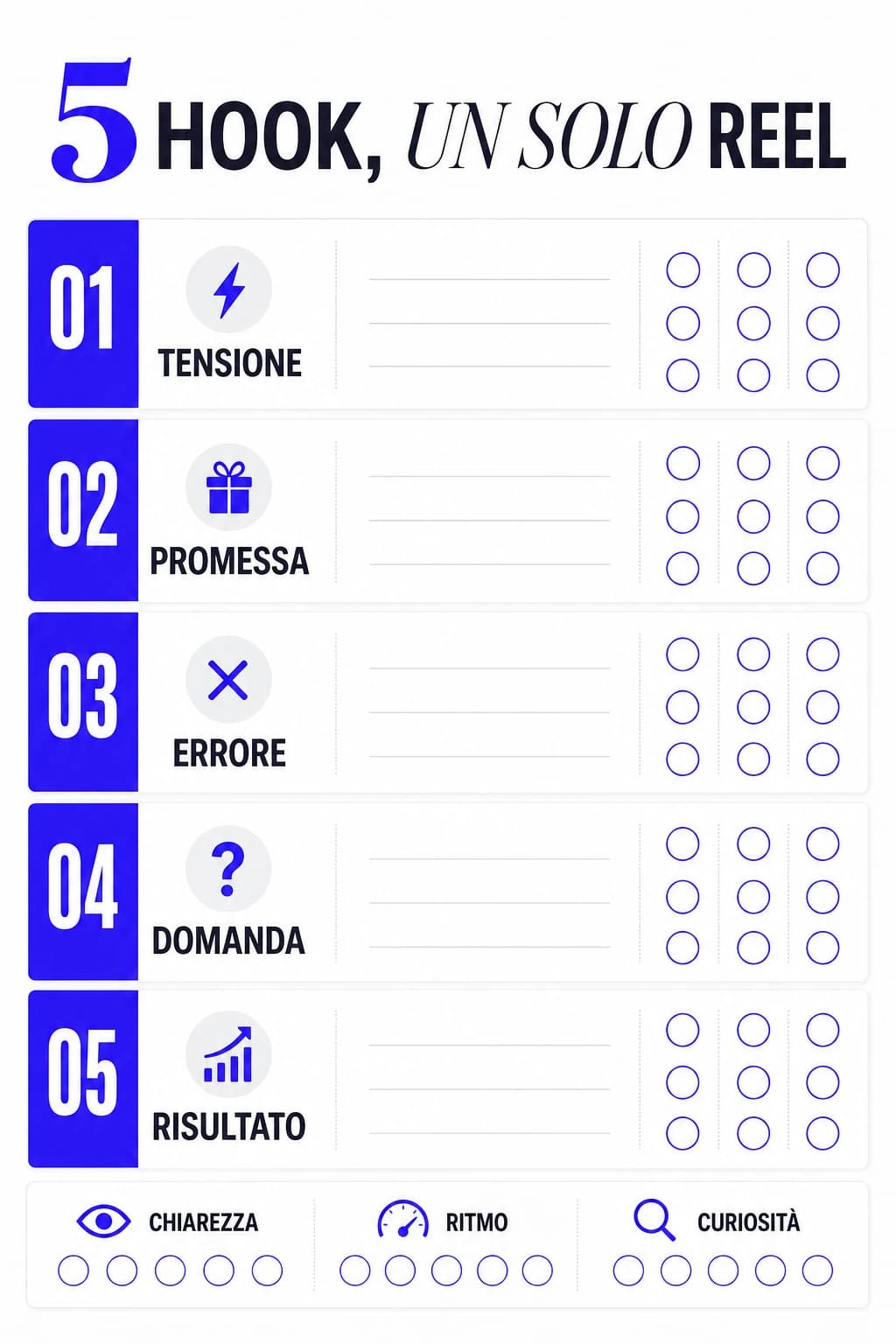
Twelve hook models to adapt
Use them as structures, not as sentences to copy:
- “If you are doing [action], check [item] first.”
- “The problem of [missed result] is often not [obvious cause].”
- “Before using [tool], decide this.”
- “Three signs your [process] is losing effectiveness.”
- “I rewrote [item] starting from just one criterion.”
- “This is the part of [activity] that almost no one documents.”
- “If I only had [constraint], I would start here.”
- “You don't need [resource] anymore: you need a way to [result].”
- “Here's what changes between [option A] and [option B] in practice.”
- “The data seems positive, but without [context] it can deceive you.”
- “From [common source] you can get at least [number] contents.”
- “The question to ask before publishing [format].”
Each model must be completed with specific details. “Three Mistakes You're Making” is generic; “three points at which a sequence of Stories loses focus” already gives some context.
How to test hooks without changing the entire Reel
To understand if the opening influences the result, keep the rest as stable as possible:
- same theme and promise;
- comparable duration;
- similar production quality;
- audience and time of publication noted;
- main variable limited to opening.
Don't treat a single result like a law. Look for patterns across multiple pieces of content and also record the quality of the responses you get.
Advantages
- It makes the value understandable faster
- Helps write more focused scripts
- Allows controlled tests on the opening
Limits
- Overpromising destroys trust
- The result also depends on the rest of the video
- Formulas become recognizable if they are not adapted
Common mistakes in the first few seconds
- Greet and introduce yourself before introducing the topic.
- Use abstract words where a concrete case is needed.
- Promising a result that the video doesn't demonstrate.
- Put two problems and three recipients in the same sentence.
- Copy an aggressive tone incompatible with the brand.
- Confusing surprise with visual noise.
- Optimize the opening and neglect the continuity of the script.
Frequently asked questions
Does the hook also have to be written on the screen?
Text, voice and image should work together. Repeating exactly the same sentence can be helpful for clarity; in other cases the text may specify recipient or result.
Should we use numbers?
Only when the number makes the promise more precise. An arbitrary number doesn't turn a weak idea into a good opening.
Does a negative hook work better?
It may attract attention, but the cost on tone and trust must be considered. Contrast is useful; systematic alarmism makes the content interchangeable.