
- Time needed
- 60 minutes to set up the system
- Difficulty
- Intermediate
- Cost
- Free, excluding production tools
- Tools
- Instagram, editorial sheet, asset archive
- Check
- Updated July 20, 2026
How I think about Stories as a system
I consider Stories a daily operating system, not a collection of fragments. I first decide which objectives to serve, which sources fuel the ideas, who produces the assets, when I publish and what signals I will use to understand whether to continue, correct or stop.
The point is not to fill twenty-four hours with content. It is creating a recognizable continuity between what the brand promises, what it shows and the action it proposes.
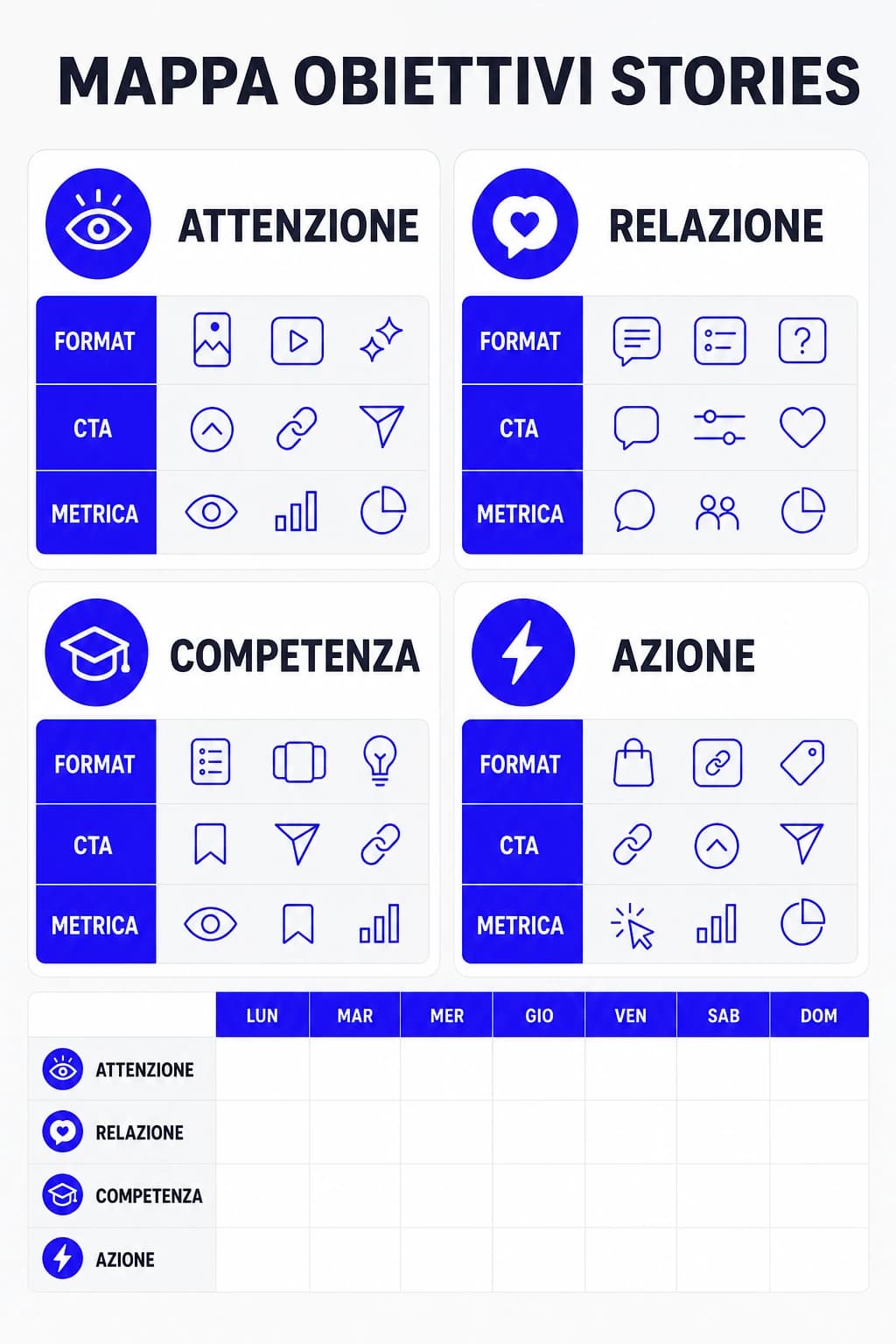
The four objectives that a Story can serve
1. Attention
Open a conversation with a fact, a tension, a result or a concrete question. The first screen must immediately make it clear why it is worth staying.
2. Relationship
Show process, criteria, people and decisions. It doesn't mean sharing everything: it means making visible the way the brand works.
3. Try
Bring evidence: before and after, mini cases, demonstrations, contextualized feedback, data or steps from real work.
4. Action
Indicate the next step with a coherent call to action: reply, visit a resource, sign up, ask for information or save a reminder.
How to set up your strategy in seven steps
- Choose a business objective. Start with a real priority: business inquiries, bookings, launch, retention or customer education.
- Define the observable action. Decide what the user should do at the end of the sequence.
- Gather your sources. Customer questions, meetings, reviews, objections, cases and behind the scenes fuel the plan.
- Assign a format. Transform each source into the most suitable format: tutorial, test, project diary, comparison or response.
- Build the sequence. Order the opening, context, value, evidence, and call to action.
- Prepare assets. Text, videos, screenshots and links must be available before publishing.
- Record the result. Note sequence behavior and quality of generated actions, not just views.
How to build a sequence of Stories
A simple sequence can follow five blocks:
- Opening: introduces a problem, desire or result.
- Context: explains who it is relevant to and in what situation.
- Value: offers procedure, criterion or point of view.
- Proof: Shows a testable item.
- Action: proposes a single, understandable step.
Not every sequence needs all five blocks. A quick reply can fit into two screens; a practical case may require eight. Length is a consequence of the message, not a goal.
Advantages
- Reduces daily improvisation
- Link content to goals
- Makes it easier to reuse sources and assets
Limits
- Requires periodic inspection
- It does not replace creative judgment
- It must be adapted to the data and context of the profile
Which signals to measure
Read data as a question, not as a habit:
- Does the first screen hold? Compare how many people enter the sequence and how many continue.
- Does the content generate a response? See relevant interactions, not just random touches.
- Is the call to action understood? Measure clicks, responses or visits consistent with the proposed step.
- Is the format repeatable? Evaluate production cost, time and quality of the result.
- Does the content help sales? Connect, whenever possible, conversations and requests to the topic that generated them.
The single data says little. It is the comparison between sequences with similar objectives that produces a useful decision.
The mistakes that weaken Stories
- Post unplugged screenshots just to “be there”.
- Open with long premises before explaining the point.
- Insert multiple calls to action in the same sequence.
- Using evidence without context or unverifiable results.
- Replicate other people's formats without adapting them to the brand's voice.
- Evaluate everything from views while ignoring actions and response quality.
- Let the system become a cage and not a work base.
Frequently asked questions
How many Stories should you publish every day?
There is no one-size-fits-all number. Start with the ability to maintain a readable and useful sequence, then compare results and production cost to find a sustainable frequency.
Is it necessary to always show your face?
No. Voice, screens, products, environments, demonstrations and text can build an effective narrative. The human presence helps, but does not necessarily coincide with a close-up.
Does every sequence have to sell?
Each sequence should serve a function. Some prepare the ground, others demonstrate, others convert. Always asking for a sale can reduce attention and trust.
How do I know if a sequence is working?
Compare sequences with the same feature and see more signals: reach, completion, replies, taps on the link and conversations generated. A single metric is not enough to explain the result.