
- Time needed
- 2 hours for the first workflow
- Difficulty
- Advanced
- Cost
- Variable
- Tools
- Source archive, AI model, automation, editorial calendar
- Check
- Updated July 20, 2026
What do I mean by content factory
I call content factory a repeatable system that connects a source to multiple contents without breaking the thread between evidence, decision and publication. It's not software and it's not a chain that writes itself. It is an operational agreement on inputs, roles, controls, versions and metrics.
A healthy factory maintains the link between each piece of content and its source. This way the reviewer can verify statements, retrieve context and update the output when the information changes.
Architecture in six steps
- Collection: sources enter an archive with owner, date and permissions.
- Selection: a manager decides what deserves to become content and for what purpose.
- Extraction: AI identifies concepts, examples, questions and possible angles without inventing missing data.
- Transformation: the selected cores become outlines, scripts, posts, emails or visual briefings.
- Review: One person reviews accuracy, voice, rights, usefulness, and call to action.
- Delivery and Learning: Approved content is scheduled; results and feedback return to the system.
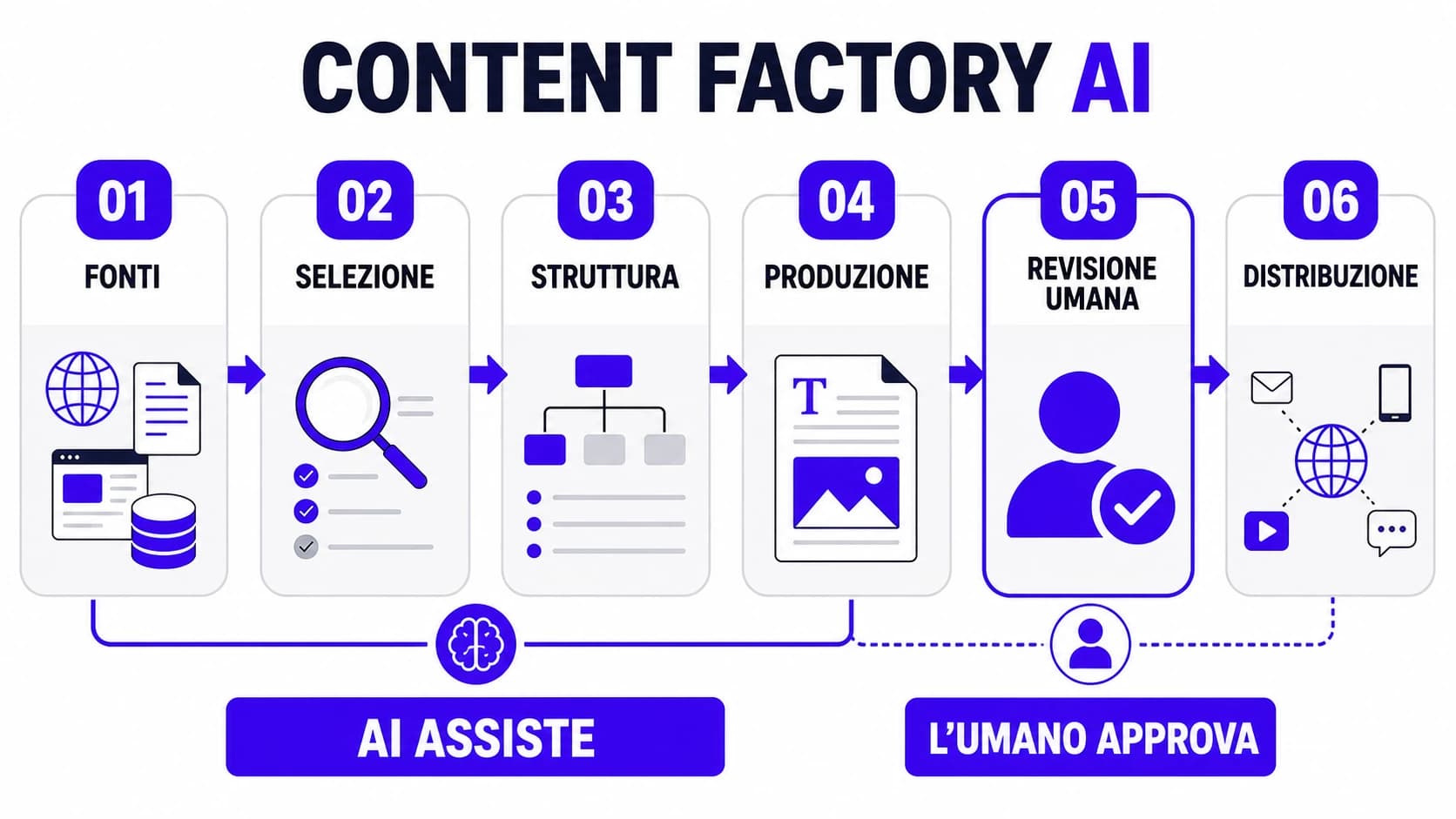
What to delegate to AI and what to keep human
Activities suitable for AI
- Transcribe and organize previously authorized materials.
- Group recurring questions and themes.
- Propose outlines and controlled variations.
- Adapt an approved core to format constraints.
- Report duplications, missing fields and inconsistencies.
- Prepare checklist for review.
Activities that require human responsibility
- Decide on strategy and priority.
- Evaluate truth, relevance and risk.
- Authorize use of data, images and testimonials.
- Add experience, opinion and original evidence.
- Approve the publication.
- Interpret results and change the system.
How to build the first workflow
Start with a single source type and a single output. For example: business question → draft LinkedIn post.
- Define the format of the source and where it is saved.
- Create the required fields: date, author, context, permissions, objective.
- Write extraction statements with an explicit rule for missing data.
- Generate a structured draft, not “ready” content.
- Assign the review to a person and record the outcome and changes.
- Publish manually during the pilot phase.
- After ten cases, identify the repetitive step that is worth automating.
Adding five channels and three automations before you have a stable transition only increases the number of hard-to-diagnose errors.
The quality control checklist
Before approval, check:
- Source: Is each important statement linked to available material?
- Accuracy: Are numbers, names, functions and dates verified?
- Experience: Does the content include a real example, decision, or limitation?
- Voice: Are the vocabulary and position consistent with the brand?
- Usefulness: Can the reader do something concrete?
- Rights: Are personal data, images, quotes and testimonials usable?
- Distribution: Are the format and call to action suitable for the channel?
- Update: Is it clear when and why the content will need to be revised?
Advantages
- Better reuse the knowledge already produced
- Reduces repetitive steps and coordination times
- It makes sources, responsibilities and status visible
Limits
- Quickly amplifies even errors and weak materials
- Requires governance, permissions and maintenance
- It is not a substitute for strategy, experience and review
How to understand if the factory is working
Measure the system on four levels:
- Efficiency: Average time from source to draft and from draft to approval.
- Quality: percentage of approved drafts, rejection reasons, recurring changes.
- Distribution: produced formats and effective reuse of each source.
- Impact: Conversations, leads, signups, or other actions linked to your goals.
The number of contents is a measure of capacity, not proof of value.
Frequently asked questions
Do you need a database?
Not at the beginning. A well-structured archive may be enough for the pilot. The database becomes useful when volumes, permissions, states and relationships exceed what the current system clearly handles.
Can publishing be automated?
Yes, after stabilizing sources, formats and approval. During the pilot, a manual publish or approved queue reduces risk.
How much content should a content factory produce?
Those that the team manages to verify, distribute and learn to improve. A factory that generates more drafts than review capacity creates inventory, not authority.
Where is it best to start from?
From the richest and most repeatable source in the business: often business questions, webinars, customer meetings or already approved internal documentation.